Vishnu Sahasranama from Mahabharata: Complete Translation & Benefits
 Chantly EditorUpdated 39 min readHow we check texts
On this page
Read this mantra in ChantlyMeaning, audio and a mala counter. Free on Android.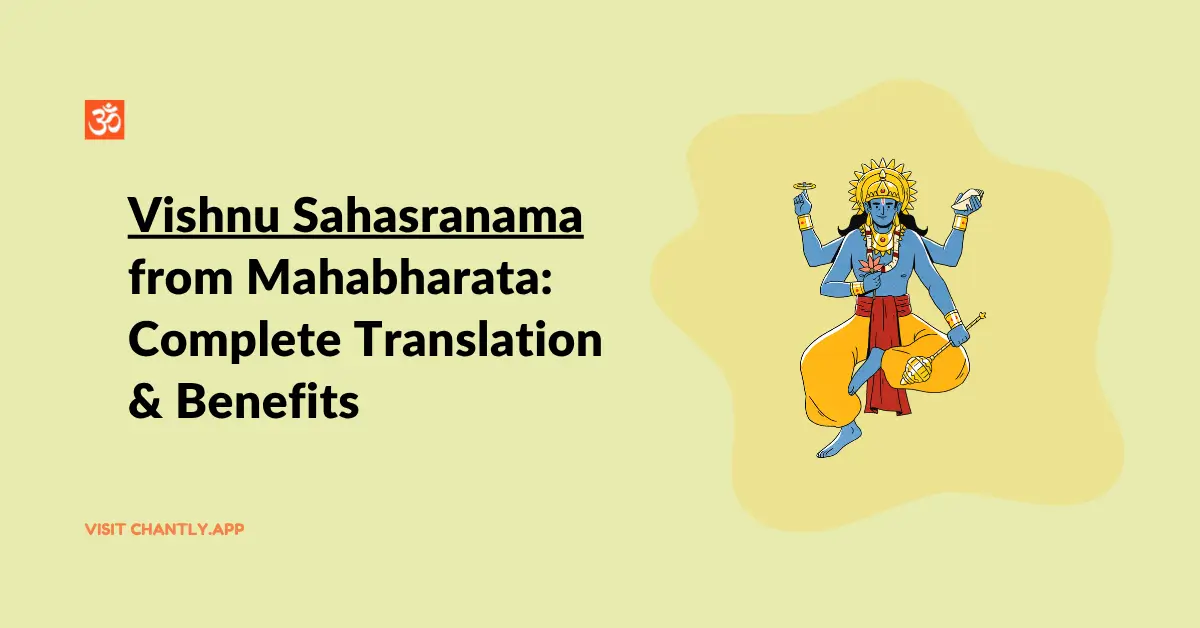
Introduction
The Vishnu Sahasranama, meaning “the thousand names of Vishnu”, is one of Hindu devotional literature’s most sacred and powerful texts. These 1000 holy names of Lord Vishnu were revealed under extraordinary circumstances on the blood-soaked battlefield of Kurukshetra by the dying warrior-sage Bhishma Pitamah to Yudhishthira, the eldest Pandava prince, burdened with doubt and grief after the devastating Mahabharata war.
This revelation wasn’t given in a peaceful ashram or temple but on a bed of arrows—Bhishma lying mortally wounded yet alive by his unique boon to choose the moment of his death. The dialogue occurred in the presence of Lord Krishna himself and the great sage Vyasa, who later recorded this sacred teaching in the Anushasana Parva (Book of Instructions) of the Mahabharata. This dramatic context elevates the Vishnu Sahasranama beyond ordinary prayer—it represents the final spiritual gift from one of dharma’s greatest exemplars at his moment of departure from the world.
Many devotees attempt this profound sacred text without understanding its Mahabharata origins, the extraordinary circumstances surrounding Bhishma’s revelation, Yudhishthira’s six fundamental questions that prompted the teaching, or the more profound meanings encoded in the systematic categories of names describing Vishnu’s cosmic functions as creator, preserver, destroyer, supreme soul, and ultimate reality itself.
This authoritative guide provides everything needed for serious practitioners: the complete Mahabharata context revealing why Bhishma chose this teaching as his final gift, detailed explanation of the 1000 names’ structure and major categories, comprehensive spiritual and material benefits backed by traditional wisdom, proper traditional recitation methods including viniyoga, nyasa, and dhyana, simplified approaches for modern practitioners, and guidance for both beginners approaching this advanced practice and experienced devotees deepening their understanding.
Whether seeking the ultimate liberation (moksha) that Bhishma promised, material prosperity and protection, or simply a deeper connection with Lord Vishnu, the Sahasranama offers a complete spiritual technology encoded in divine names that have transformed countless lives across millennia.
The Mahabharata Story – Bhishma’s Final Gift
Understanding the dramatic circumstances of this revelation transforms the Sahasranama from abstract theology into urgently relevant spiritual wisdom offered at Dharma’s darkest hour.
The Post-War Devastation:
The great Kurukshetra war had ended. Eighteen days of brutal combat involving millions of warriors had concluded with the Pandavas’ victory but at what cost? The battlefield lay strewn with the bodies of countless soldiers, teachers, relatives, and friends.
Among the fallen were revered figures like Dronacharya, Karna, and all the Kauravas, including Duryodhana. The earth itself seemed to weep from the bloodshed.
Yudhishthira, now king, found himself overwhelmed with grief, guilt, and existential questions. Though his cause had been righteous and victory divinely ordained, he couldn’t escape the horrifying reality that his kingship was built upon mountains of corpses, many of them his own relatives. The dharmic complexity of the war where righteousness required fratricide and duty demanded destruction created a profound spiritual crisis.
What good was victory if it cost everything worth living for? What was Dharma’s purpose if following it created such devastation? How could one find peace after such violence, even when violence was necessary? These questions tormented Yudhishthira’s conscience as he surveyed the war’s aftermath.
Krishna’s Divine Guidance:
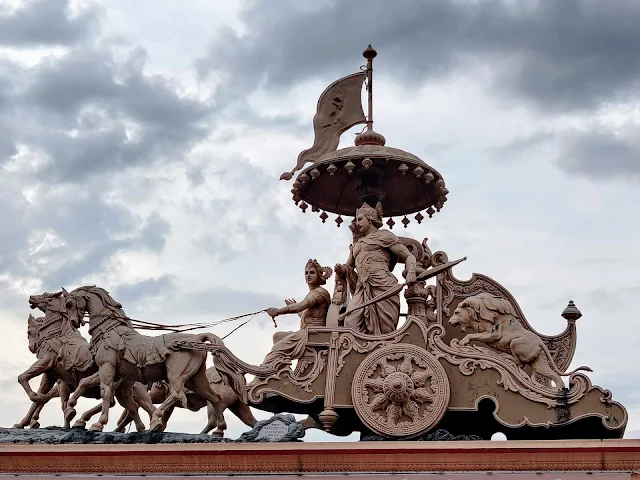
Recognising Yudhishthira’s spiritual crisis, Lord Krishna who had served as Arjuna’s charioteer and the Pandavas’ guide throughout the war led the grieving king to someone uniquely qualified to answer these profound questions: Bhishma Pitamah, the grandsire of both the Kauravas and Pandavas, who lay on his bed of arrows awaiting the auspicious time to depart his body.
Krishna knew that only Bhishma possessed the wisdom, authority, and proximity to death to address Yudhishthira’s spiritual crisis with ultimate authenticity. A man about to leave the world speaks only essential truth there’s no time left for anything else.
Bhishma’s Extraordinary Position:
Bhishma (literally “the terrible” or “the awesome”) was no ordinary warrior or sage. Born as Devavrata, he was the son of King Shantanu and the celestial river goddess Ganga. His position as the Kuru dynasty’s grandsire made him elder to everyone involved in the war both Kauravas and Pandavas viewed him as the family patriarch and repository of ancient wisdom.
Most remarkably, Bhishma possessed the boon of Iccha Mrityu the ability to choose the moment of his own death. This boon resulted from his terrible vow (Bhishma Pratigya) taken in youth: to remain celibate forever and renounce all claim to the throne so his father could marry the fisherwoman Satyavati. This supreme sacrifice of personal happiness for his father’s wishes earned him extraordinary blessings from celestial beings.
During the war, Bhishma had fought on the Kaurava side not from agreement with their unrighteous cause but from his binding oath to serve whoever sat on the Hastinapur throne. This created the tragic situation of Dharma incarnate fighting against Dharma’s cause due to inflexible loyalty. The conflict between duty to one’s word (satya) and duty to righteousness (Dharma) embodied the war’s terrible complexity.
Arjuna had finally defeated Bhishma on the tenth day of battle, but only through Krishna’s strategy. The grandsire, recognising that his continued presence prolonged unnecessary bloodshed, revealed how to defeat him to the Pandavas. He was pierced by so many of Arjuna’s arrows that his body never touched the ground he lay suspended on a bed of arrows (Shara Shaiya), waiting for Uttarayana (the sun’s northward movement) as the auspicious time to depart.
The Sacred Dialogue:
When Krishna brought Yudhishthira to Bhishma’s arrow-bed, the grandsire remained conscious and lucid despite his mortal wounds another manifestation of his extraordinary spiritual power. The scene was profound: the dying warrior who had witnessed the dynasty’s entire tragedy, the victorious king tortured by doubt, the divine Krishna observing, and the sage Vyasa documenting everything for posterity.
Yudhishthira prostrated before his grandsire and asked six fundamental questions that go to the heart of human existence:
Question 1: “Who is this universe’s param tattva (supreme reality)?”
This addresses the ultimate metaphysical question what is the fundamental nature of reality itself? What represents the highest truth among all the gods, philosophies, and spiritual paths?
Question 2: “What is the greatest dharma?”
After a war fought ostensibly for Dharma, which resulted in such devastation, Yudhishthira needed to understand what Dharma truly meant. What principle supersedes all others when duties conflict?
Question 3: “By glorifying whom can a man be freed from all bondage of samsara?”
This question addresses liberation how does one escape the cycle of birth, death, and rebirth that traps consciousness in suffering? Which divine being or principle offers this ultimate freedom?
Question 4: “What is the one practice that leads to moksha?”
Which single practice suffices for liberation among countless spiritual practices, rituals, and disciplines? For those with limited time and capacity, what is the essential practice?
Question 5: “Who should be worshipped to attain both sukh (happiness) and moksha (liberation)?”
This question seeks the path that addresses worldly well-being and ultimate spiritual freedom not requiring one to sacrifice material welfare for spiritual progress or vice versa.
Question 6: “What is the easiest way to remove all paap (sins) and attain punya (virtue)?”
This final question addresses practical spiritual purification how does one cleanse accumulated karmic debts and establish positive spiritual momentum?
These six questions represent complete spiritual inquiry covering ultimate reality, proper conduct, liberation mechanism, essential practice, comprehensive worship, and practical purification. They’re not abstract philosophical curiosities but urgent questions from a man facing the consequences of having done terrible violence in Dharma’s name.
Bhishma’s Definitive Response:
Bhishma smiled perhaps the first genuine smile since the war began. Here, finally, was the opportunity to give his beloved Yudhishthira the ultimate teaching that would resolve all confusion. His response was unequivocal:
“All your questions have one answer: Lord Vishnu. He is the Sarvavyapak (omnipresent) Parmatma (supreme soul) who protects, nurtures, and governs the entire universe. He is the param tattva you ask about. Glorifying Him liberates from samsara. Worshipping Him grants both worldly happiness and ultimate liberation. Chanting His names removes all sins.”
Bhishma then recited the thousand sacred names of Lord Vishnu names that systematically reveal Vishnu’s complete nature as creator, preserver, destroyer, immanent presence, transcendent reality, and ultimate refuge for all beings. Each name described a specific aspect of Vishnu’s infinite being, forming a comprehensive portrait of the Supreme.
The Sacred Witnesses:
This teaching didn’t occur in isolation. Lord Krishna himself who devotees recognise as Vishnu’s complete avatar was present, validating the teaching through his divine presence. The fact that Krishna, whom the Bhagavad Gita establishes as the Supreme Personality of Godhead, witnessed and approved Bhishma’s teaching gives it ultimate authority.
Sage Vyasa, the compiler of the Vedas and author of the Mahabharata itself, also witnessed this dialogue. Later, he recorded it in the Anushasana Parva (Book of Instructions), the penultimate book of the Mahabharata. This ensured that Bhishma’s final teaching wouldn’t be lost to time but would remain available for all future generations seeking the same answers Yudhishthira sought.
Why This Story Matters:
Understanding this context transforms how practitioners approach the Vishnu Sahasranama. This isn’t merely a poetic list of divine names that some anonymous ancient author composed. These are the final words of one of Dharma’s greatest exemplars, spoken from a bed of arrows in the presence of the divine, specifically designed to answer the six most fundamental questions human beings can ask about existence, purpose, and liberation.
When devotees recite these names, they’re not just performing a ritual they’re receiving the same teaching Bhishma gave Yudhishthira at humanity’s darkest hour. The names carry the authority of a dying sage who had nothing left to gain from deception, witnessed by the divine itself, and recorded by the most excellent compiler of spiritual wisdom in Hindu tradition.
This origin story also addresses a common question: why should followers of other traditions or agnostics respect this text? Because it addresses universal human questions suffering, meaning, liberation with concrete practice rather than abstract philosophy. Bhishma didn’t tell Yudhishthira to believe certain doctrines or perform complex rituals. He gave him names to chant a practice anyone can attempt regardless of background, then verify through personal experience whether the promised benefits manifest.
The battlefield setting also matters profoundly. Bhishma could have taught this in a peaceful ashram surrounded by flowers and incense. Instead, it came from a bed of arrows on blood-soaked ground surrounded by the aftermath of history’s greatest war. This shows the teaching isn’t for those in comfortable circumstances seeking spiritual entertainment. It’s emergency medicine for souls in crisis the spiritual equivalent of battlefield triage.
Yudhishthira’s questions were urgent, born from genuine suffering and confusion. Bhishma’s answer was equally direct: here are the names, chant them sincerely, and all your questions will be answered through direct experience. This immediacy and practicality characterise the Vishnu Sahasranama’s genius it offers experiential verification rather than requiring blind faith.
Understanding the 1000 Names Structure
The Vishnu Sahasranama isn’t merely a random collection of divine epithets but a systematically organised revelation of the Supreme Being’s complete nature and functions.
The Actual Count and Its Significance:
While traditionally called the “thousand names” (Sahasranama), the text contains 1,031 individual names. The extra 31 names are typically considered adjectives or descriptive phrases rather than independent names, though this distinction varies among commentators. Some scholars count exactly 1000 by grouping specific compound names, while others acknowledge all 1,031. This numerical precision matters less than the symbolic significance “sahasra” (thousand) in Sanskrit represents completeness and vastness rather than strict mathematical exactness.
The thousand (or slightly more) names together form a complete portrait of Vishnu like viewing a multifaceted diamond from every angle, each name reveals one facet of infinite divinity. No single name or group of names could capture the entirety of the Supreme Being; the profusion of names acknowledges that even a thousand barely begins to describe the infinite.
The Author and Compiler:
While Bhishma recited these names on the battlefield, Sage Vyasa (also known as Veda Vyasa or Krishna Dvaipayana) compiled and composed them into our current structured text. Vyasa holds unique authority as the compiler of the four Vedas, author of the Mahabharata and Puranas, and one of the immortal Chiranjivi who still walk the earth according to tradition.
Vyasa’s role as compiler ensures the text’s technical precision proper meter, linguistic accuracy, and systematic organisation that makes the names suitable for recitation and memorisation. The names Bhishma spontaneously recited in his divine state of consciousness received formal structure through Vyasa’s literary genius, making them accessible to practitioners across millennia.
Location in the Mahabharata:
The Vishnu Sahasranama appears in the Anushasana Parva (Book of Instructions), the penultimate book of the Mahabharata. This section contains Bhishma’s final teachings on various aspects of Dharma given during the 58 days he lay on his arrow-bed, teaching Yudhishthira before departing during Uttarayana. The placement is significant coming after the war’s devastation but before the Pandavas’ eventual retirement, representing the wisdom needed to live righteously after experiencing life’s complete tragedy and triumph.
Specifically, it comprises the 149th chapter (though numbering varies in different editions). It is considered one of the most sacred portions of the entire epic. Many Hindu families own copies of the Sahasranama extracted from the larger Mahabharata, treating it as an independent sacred text worthy of daily recitation.
Traditional Technical Elements:
Every Vedic mantra or stotra includes specific technical information called the Viniyoga, which practitioners recite before beginning formal practice:
Rishi (The Seer): Vedavyasa is the rishi the sage who first “saw” or realised these names in elevated consciousness. Acknowledging the rishi honours the lineage through which the teaching comes and connects practitioners to the unbroken tradition of Vishnu worship.
Devata (The Deity): Narayana (another name for Vishnu) is the devata the divine being to whom the hymn is dedicated and whose grace the recitation invokes. This specifies that all 1000 names ultimately refer to one Supreme Being in various aspects rather than separate entities.
Chanda (The Meter): Anustubh is the primary poetic meter a Sanskrit verse form with specific syllabic patterns that create rhythmic flow conducive to memorisation and devotional recitation. Some verses use other meters like Trishtubh, but Anustubh predominates, giving the text musical quality when chanted aloud.
These technical details aren’t pedantic they’re part of the spiritual technology ensuring the recitation’s effectiveness. Just as a medicine’s chemical formula determines its therapeutic action, the mantra’s technical specifications determine its spiritual effect.
The Overall Structure:
The complete Vishnu Sahasranama Stotram consists of:
Opening Invocation: Prayers to remove obstacles and invoke Ganesha and other deities’ blessings.
Dhyana Verses: Meditation verses describing Vishnu’s form the famous “Shantakaram Bhujagashayanam” (peaceful, reclining on the serpent) and “Shuklambaradharam Vishnum” (clothed in white, all-pervading Vishnu). These verses help practitioners visualise the deity before chanting the names.
Primary Text: 107 or 108 shlokas (verses) containing the thousand names, typically organised in groups with each shloka containing multiple names strung together in compound form.
Phala Shruti: The “fruits of recitation” section describes the benefits gained from sincere practice this concludes the text by explaining what devotees can expect from consistent chanting.
Major Categories of Divine Names:
The thousand names aren’t random but systematically cover Vishnu’s multifaceted nature:
1. Creator Aspect (Srishti-karta):
Names like Bhuta-Krit (creator of beings), Vidhata (ordainer/arranger), Brahma (the vast/expanding one), and Dhatri(supporter) describe Vishnu’s role in manifesting the universe from unmanifest potential. These names acknowledge that all creation emerges from Vishnu’s will and power the Supreme Being doesn’t create from outside, but manifestation occurs within divine consciousness.
Examples include:
- Prajapati (lord of creatures)
- Srishta (creator)
- Visvakarmaa (architect of the universe)
These names address the cosmological question: where did everything come from? The answer: from Vishnu’s infinite creative power.
2. Preserver/Sustainer Aspect (Sthiti-karta):
Names like Bhuta-Bhrt (sustainer of beings), Bhutabhavana (one who nourishes all creatures), Vishvabhug (protector of the universe), and Yogeshah (lord of yoga/union) describe Vishnu’s ongoing role in maintaining creation. These names are perhaps most numerous since preservation requires constant effort like a father who not only begets children but must care for them continuously.
Examples include:
- Poshaka (nourisher)
- Hiranyagarbha (golden womb containing all)
- Lokanatha (lord of the worlds)
- Vishvaksena (he whose army is the universe itself)
These names address the practical question: what sustains existence moment to moment? The answer: Vishnu’s continuous preserving power.
3. Destroyer/Transformer Aspect (Samhara-karta):
Names like Samhara (destroyer), Kala (time/death), Mrityunjaya (conqueror of death), and Antaka (ender) describe Vishnu’s role in dissolving creation back into unmanifest potential. This isn’t malevolent destruction but necessary transformation old forms must dissolve for new forms to emerge, just as last year’s leaves must decompose to nourish next year’s growth.
Examples include:
- Pralaya (dissolution)
- Vibhu (all-pervading, especially at cosmic dissolution)
- Nirodha (one who restrains/contains at the end)
These names address the fearful question: what happens when everything ends? The answer: it dissolves back into Vishnu, awaiting the next cycle of manifestation.
4. Cosmic Form (Virat-Svarupa):
Names like Vishvam (the universe itself), Virat (the cosmic person), Purusha (the primordial being), and Visvakrit(maker of the universe) describe Vishnu as identical with creation itself not just its external creator but its very substance. These names present the profound non-dual philosophy that the creator and creation aren’t separate divinity doesn’t reside “somewhere else” but constitutes the fabric of reality itself.
Examples include:
- Sarva (all/everything)
- Visva-murdhaa (he whose head/source is the universe)
- Vishvarupa (one who contains all forms)
- Vyapti (the all-pervading)
These names address the philosophical question: where is God? The answer: everywhere, as everything, since the universe and Vishnu are non-different.
5. Supreme Soul (Paramatma):
Names like Paramatma (supreme soul), Purusha (consciousness), Atma (the self of all), Jiva (life principle), and Chaitanya (consciousness itself) describe Vishnu as the innermost reality of every being. These names present the Upanishadic truth “Tat Tvam Asi” (That Thou Art) the divinity worshipped externally is identical with one’s own deepest self.
Examples include:
- Sarvatma (soul of all)
- Hridayastha (residing in the heart)
- Jyotir-aadi (primordial light of consciousness)
- Pratyagatma (inner self)
These names address the existential question: who am I? The answer: ultimately, one’s true self is non-different from Vishnu.
6. Divine Attributes (Divya Gunas):
Hundreds of names describe Vishnu’s qualities:
Eternality: Achyuta (infallible, never falling from truth), Avyaya (imperishable), Ananta (infinite), Anadi (without beginning)
Omnipotence: Sarvashaktiman (all-powerful), Mahavira (great hero), Balabhadra (auspicious strength)
Omniscience: Sarvajnya (all-knowing), Prajnyaana (supreme wisdom), Vedavit (knower of Vedas)
Transcendence: Nirguna (beyond qualities), Nirakara (formless), Avyakta (unmanifest)
Immanence: Saguna (with qualities), Sakara (with form), Vyakta (manifest)
Benevolence: Dayalu (compassionate), Bhaktavatsala (affectionate to devotees), Sharana (refuge)
These names reveal Vishnu’s character not an impersonal force but a Supreme Person combining infinite power with infinite compassion.
7. Avatar References:
Many names reference Vishnu’s famous incarnations:
- Narayana (referring to the original Narasimha and Vamana)
- Madhava (referring to Krishna)
- Trivikrama (the three-stepper, referring to Vamana)
- Rama (referring to both Parashurama and Rama)
- Govinda (referring to Krishna)
- Janardana (referring to Krishna)
- Madhusudana (slayer of demon Madhu, referring to Krishna)
These names remind practitioners that the abstract Supreme Being becomes accessible through avatars divine incarnations who walk among humans, demonstrating how to live righteously and offering personal relationships rather than just philosophical abstraction.
The Opening Names – Setting the Foundation:
The first few names establish the text’s foundation:
Name #1: Vishvam – “He who is the Universe itself.” The first name declares the fundamental non-dual truth Vishnu isn’t separate from creation but IS creation in its totality.
Name #2: Vishnu – “The all-pervading, omnipresent one, remover of darkness.” Vishnu derives from the root “vish”, meaning to pervade indicating divine presence in every atom of existence.
Name #3: Vashatkara – “He for whom the Vedic sacrifices are performed; the supreme refuge.” This establishes Vishnu as the goal of all rituals and practices.
Name #4: Bhuta-Bhavya-Bhavat-Prabhu – “Lord of past, present, and future.” This name addresses temporality Vishnu transcends time while governing all temporal processes.
Beginning with these names immediately establishes the text’s scope not describing a limited deity but the Supreme Reality underlying all existence across all time.
Adi Shankaracharya’s Commentary:
The great philosopher Adi Shankaracharya (8th century CE) wrote an extensive commentary on the Vishnu Sahasranama, interpreting many names through Advaita Vedanta philosophy. His commentary demonstrates that the names support multiple levels of interpretation:
- Literal meaning: The surface grammatical meaning
- Puranic meaning: References to specific mythological events
- Philosophical meaning: Non-dual interpretations equating Vishnu with Brahman (ultimate reality)
- Devotional meaning: Personal relationship aspects for bhakti practitioners
This multi-layered significance allows practitioners at different spiritual stages to derive appropriate understanding beginners connect with mythological meanings, philosophers explore metaphysical implications, and advanced devotees experience direct communion through the names.
Why Structure Matters:
Understanding this organisational structure transforms recitation from mechanical repetition to conscious meditation. When chanting names describing Vishnu as creator, the mind contemplates creative power. When chanting preserver names, one reflects on sustaining grace. When chanting destroyer names, one considers transformation and renewal.
The systematic coverage also ensures completeness no aspect of the Supreme Being remains unaddressed. This comprehensiveness explains why Bhishma offered the Sahasranama as a complete answer to Yudhishthira’s six questions. The names collectively reveal a Supreme Being who:
- IS the supreme reality (answering question 1)
- Establishes and embodies Dharma (answering question 2)
- Grants liberation when glorified (answering question 3)
- Can be worshipped through the single practice of name-chanting (answering question 4)
- Provides both worldly happiness and moksha (answering question 5)
- Removes sins through sincere recitation (answering question 6)
The thousand names aren’t poetic decoration but precise spiritual technology each name a key unlocking specific aspects of divine consciousness, forming a complete practice requiring nothing beyond sincere recitation.
Comprehensive Spiritual and Material Benefits
Traditional texts and countless devotees across millennia testify to the Vishnu Sahasranama’s extraordinary transformative power encompassing all dimensions of existence.
The Ultimate Benefit: Liberation (Moksha):
Bhishma explicitly promised that sincere recitation leads to moksha liberation from the cycle of birth, death, and rebirth(samsara). This represents Hinduism’s ultimate goal not just a comfortable existence but complete freedom from suffering inherent in conditional existence.
The mechanism works through several complementary processes:
Karma Purification: Each name chanted burns accumulated karmic impressions (samskaras) that bind consciousness to conditional existence. Like fire purifying gold, the divine names purify consciousness of limiting patterns.
Knowledge Awakening: The names reveal Vishnu’s true nature, which is non-different from one’s deepest self. This knowledge (jnana) directly dissolves ignorance (avidya), which creates the illusion of separate individuality.
Devotional Surrender: The repetitive praise of Vishnu gradually dissolves ego-identification, which is the false sense of separate self that creates all bondage. As devotion intensifies, the sense of “I am doing” transforms into “Vishnu does everything through this body-mind.”
Grace Invocation: The names don’t just describe Vishnu but invoke his direct presence and grace. Through this grace, even lifetimes of spiritual work can be accomplished suddenly like clouds parting to reveal the always-present sun.
Liberation isn’t a reward added to consciousness but the natural state revealed when ignorance and karma are removed. The Sahasranama accomplishes this removal through sustained focus on the Supreme Reality.
Complete Sin Removal:
Bhishma promised that recitation liberates from all accumulated sins (paap) across countless lifetimes. Traditional understanding categorises sins into various types:
Papa (Negative Karma): Actions creating suffering for oneself and others violence, deception, theft, etc. The names’ purifying power neutralises even severe negative karma.
Prarabdha Karma: Karma already manifesting in current life circumstances. While Sahasranama can’t undo what’s already happening, it transforms one’s relationship to circumstances, removing psychological suffering even when external situations remain challenging.
Sanchita Karma: The vast storehouse of accumulated karma from past lives awaiting future manifestation. Regular recitation burns this karmic backlog, preventing future difficulties from arising.
Agami Karma: New karma is being created through current actions. The practice creates such positive momentum that naturally ethical behaviour emerges, preventing new harmful karma accumulation.
The phala shruti (benefits section) states explicitly: “All sins committed through body, speech, and mind are destroyed for one who recites these names.” This complete purification enables spiritual progress that would otherwise require countless lifetimes of disciplined practice.
Profound Peace of Mind:
The most immediately noticeable benefit is deep mental peace (shanti). The modern mind suffers constant agitation worries about the future, regrets about the past, dissatisfaction with the present, endless desires, fears, and mental chatter.
The Sahasranama creates peace through multiple mechanisms:
Mental Focus: The practice occupies the wandering mind with devotional content, interrupting anxiety loops and negative thought patterns. Each time attention returns to the names, mental agitation decreases slightly.
Vibrational Effect: The sound frequencies of Sanskrit names create measurable effects on nervous system activity. Studies show that Sanskrit mantra recitation shifts brain waves from beta (active thinking) toward alpha and theta (relaxed awareness).
Devotional Surrender: Repeatedly acknowledging Vishnu as preserver and protector creates psychological safety. The unconscious mind registers: “I’m not alone managing everything the Supreme Being handles all difficulties.”
Karmic Neutralisation: Much anxiety stems from unconscious karmic impressions formless anxieties without apparent cause. As the names purify these deep impressions, sourceless anxiety spontaneously dissolves.
Practitioners consistently report that after several weeks of daily practice, baseline anxiety decreases noticeably. Life’s challenges continue, but the frantic mental reaction diminishes, replaced by underlying equanimity.
Divine Protection (Raksha):
Traditional texts promise that regular reciters receive Vishnu’s direct protection from:
Physical Dangers: Accidents, violence, natural disasters devotees report narrowly avoiding dangers or emerging unharmed from situations that should have caused injury.
Negative Entities: Evil spirits, black magic, negative energy from ill-wishers the names create a protective spiritual field that opposing forces cannot penetrate.
Obstacles and Enemies: Both external enemies and internal enemies (the six vices: desire, anger, greed, delusion, pride, envy) the practice neutralises opposition and transforms inner enemies into allies.
Inauspicious Influences: Astrological afflictions, curses, negative inherited karma the divine names override these influences through direct divine intervention.
This protection isn’t merely a superstitious belief. Devotees across millennia report tangible experiences of being guided away from danger, receiving unexpected help during crises, and finding that difficulties resolve mysteriously. Whether through divine intervention or the increased intuition and clarity that comes from regular practice, the protective effect is widely experienced.
Physical Health and Healing:
While not primarily a healing practice, the Sahasranama supports physical health through multiple pathways:
Stress Reduction: Since chronic stress underlies countless diseases (heart disease, digestive disorders, autoimmune conditions, chronic pain), the profound stress relief from regular practice prevents stress-related illness.
Energy Flow: Traditional understanding holds that disease results from blocked or imbalanced prana (life force). The names’ vibrations harmonise pranic flow, allowing the body’s natural healing intelligence to function optimally.
Karmic Health Issues: Some illnesses stem from karmic causes rather than physical ones. The karmic purification from sincere recitation can resolve health issues that don’t respond to conventional treatment.
Positive Mindset: The practice creates optimistic mental states that support immune function and healing. Depression and hopelessness suppress immune response; devotional joy enhances it.
Numerous devotees report improving or resolving chronic conditions after establishing consistent Sahasranama practice. While practitioners should never abandon necessary medical treatment, the spiritual practice complements conventional care effectively.
Material Prosperity and Success:
Despite being a spiritual practice aimed ultimately at liberation, the Sahasranama also brings material benefits Bhishma specifically answered Yudhishthira’s question about attaining both sukh (worldly happiness) and moksha (liberation).
Financial Abundance: Many names describe Vishnu as the source of all wealth and prosperity. Sincere recitation attracts opportunities for legitimate earning and removes obstacles to prosperity.
Career Success: The mental clarity and confidence developed through practice translate into better professional performance. Practitioners report promotions, successful businesses, and respect from colleagues.
Relationship Harmony: The ego-reduction and increased compassion from regular practice naturally improve all relationships. Family conflicts resolve more easily, friendships deepen, and even difficult relationships become manageable.
Wish Fulfilment: Traditional teaching holds that devotees’ genuine wishes are fulfilled through the practice not necessarily immediately or in expected ways, but ultimately in manners serving their true welfare.
The key insight is that material benefits arise naturally as byproducts of spiritual practice without being primary goals. The practitioner focused purely on devotion often receives unsolicited material blessings. In contrast, those practising primarily for material gain may find benefits elusive.
Rapid Spiritual Progress:
For serious spiritual practitioners, the Sahasranama accelerates progress toward realisation:
Meditation Deepening: The practice naturally quiets mental chatter, making formal meditation sessions more fruitful. Many practitioners report entering deeper states faster after establishing the Sahasranama practice.
Scripture Understanding: Regular recitation mysteriously enhances comprehension of philosophical texts. Passages that seemed obscure suddenly make perfect sense, as if the names impart the wisdom they describe.
Guru Attraction: The practice creates conditions attracting appropriate spiritual teachers. Physical gurus appear, or the inner guru (Vishnu’s guidance from within) becomes accessible.
Siddhi Development: Traditional texts mention various siddhis (spiritual powers) developing through sincere practice, though these shouldn’t be sought for their own sake. The powers emerge spontaneously as consciousness purifies.
Direct Experience: Most importantly, the names facilitate direct experiential knowledge (aparoksha jnana) of Vishnu rather than just intellectual understanding. The practitioner doesn’t just believe Vishnu exists they experience his presence directly.
Enhanced Knowledge and Wisdom:
Beyond book learning, the practice develops true wisdom (prajna) discriminating intelligence that distinguishes real from unreal, eternal from temporary, beneficial from harmful.
Scriptural Knowledge: Even without formal study, regular practitioners develop an intuitive understanding of Vedic teachings. The names contain the essence of all scriptures concentrated into a recitable form.
Life Wisdom: Practical decision-making improves dramatically. Practitioners report knowing intuitively which opportunities to pursue, which relationships to cultivate, and which risks to take.
Self-Knowledge: Most importantly, the practice reveals one’s true nature. The false identification with body, mind, and personality gradually dissolves, revealing the eternal self that is non-different from Vishnu.
This wisdom solves problems that intellect alone cannot resolve. The intellectually brilliant person lacking wisdom makes terrible life decisions despite a high IQ; the simple devotee with awakened wisdom navigates life’s complexities with grace.
Removal of Astrological Afflictions:
Vedic astrology identifies various planetary positions (doshas) creating difficulties:
Navagraha Dosha: Afflictions from the nine planets the names’ power overrides negative planetary influences.
Kaal Sarpa Dosha: Particular alignment is considered highly inauspicious, but regular recitation neutralises this influence.
Rahu-Ketu Afflictions: The shadow planets cause sudden, unexpected difficulties, and the practice provides protection.
Sade Sati: Saturn’s challenging seven-and-a-half-year transit devotees report navigating this period with minimal difficulty through consistent Sahasranama practice.
Whether one accepts astrology’s literal truth or views it as psychological symbolism, practitioners consistently report that life’s challenges decrease and inauspicious periods become surprisingly manageable through sincere recitation.
Family Harmony and Domestic Peace:
The practice benefits not just the individual but their entire household:
Marital Harmony: Ego conflicts that poison marriages diminish as the ego dissolves. Practitioners become more patient, understanding, and forgiving partners.
Parent-Child Relationships: The compassion developed through practice creates better parenting. Children sense the spiritual energy in the home and benefit from the peaceful atmosphere.
Extended Family: Even relatives who do not practice themselves benefit from one family member’s sincere devotion. Conflicts resolve mysteriously, health improves, and prosperity increases.
Environmental Purification: The sound vibrations literally purify the physical environment. Homes where the Sahasranama is regularly recited develop tangibly peaceful atmospheres that visitors immediately notice.
Many families establish the practice as a daily group activity children learn the names alongside parents, create a shared spiritual foundation, and strengthen family bonds across generations.
Mental Purification and Character Transformation:
Perhaps most valuable are the subtle character changes occurring through consistent practice:
Anger Reduction: The hot reactivity that poisons relationships and creates suffering gradually cools into patient equanimity.
Desire Moderation: Insatiable craving for sensory pleasures naturally moderates without forced suppression. One still enjoys life but without desperate grasping.
Fear Dissolution: The existential anxiety underlying so much human suffering fear of death, abandonment, failure dissolves into trust in divine providence.
Jealousy Elimination: The painful comparison with others naturally ceases when one recognises all beings as manifestations of the same Vishnu.
Pride Reduction: The ego’s constant need to feel superior and exceptional naturally deflates through repeatedly acknowledging the Supreme Being’s infinite superiority.
Attachment Loosening: While still caring for loved ones and responsibilities, the desperate clinging that creates suffering gradually releases.
These changes occur organically without forced self-improvement projects. The names transform consciousness the way flowing water gradually smooths rough stones not through violent impact but through persistent gentle contact.
The Extraordinary Promise:
The phala shruti concludes with extraordinary promises that might seem hyperbolic if not backed by countless testimonies:
“One who recites this with devotion never experiences poverty, grief, fear, or untimely death. They attain all desired objects. Their sins are destroyed. They obtain the vision of Lord Vishnu. They ultimately merge with Vishnu himself.”
These benefits aren’t restricted by caste, gender, or religious affiliation. The text explicitly states that all sincere reciters regardless of background receive these blessings. The only requirements are sincerity, consistency, and devotion.
Important Qualifier:
All these benefits manifest in proportion to sincerity and consistency mechanical recitation while mentally elsewhere produces minimal effects. Sincere devotional practice transforms life comprehensively. The Sahasranama isn’t a magic spell forcing reality to bend to the practitioner’s will it’s spiritual technology requiring proper application to produce results.
Also, the practice complements but doesn’t replace appropriate worldly action. The devotee must work honestly, treat others ethically, maintain health, and fulfil responsibilities. Sahasranama practice empowers right action rather than substituting for it.
Complete Recitation Method and Procedure
Traditional procedure maximises the Sahasranama’s spiritual efficacy while ensuring a respectful approach to this sacred practice.
Fundamental Preparation:
Physical Purification: The ideal sequence begins with waking during Brahma Muhurta (approximately 1.5 hours before sunrise), performing all morning ablutions, and bathing thoroughly. Physical cleanliness symbolises and supports mental purity, creating an appropriate psychological state for approaching the sacred.
For those unable to bathe due to circumstances, washing the hands, feet, face, and mouth at a minimum suffices. The key is conscious purification rather than mere mechanical washing feeling the water removes physical dirt and psychological impurities.
Clothing: Wear freshly laundered clothes in colours associated with Vishnu yellow being most traditional, though white, saffron, or blue also work well. Avoid black or other inauspicious colours. Keep clothing loose and comfortable to support a relaxed, upright posture during extended recitation.
Some traditional practitioners wear specific clothes only for spiritual practice, never for ordinary activities. This creates a psychological association wearing the practice clothes automatically triggers devotional consciousness.
Location and Direction: Select a quiet, clean space where interruptions are unlikely. Face east (direction of rising sun, symbolising spiritual illumination) or north (direction of Mount Kailash and the Himalayas, considered the seat of spiritual power). While facing these directions isn’t mandatory, traditional orientation honours timeless wisdom about subtle energy flows.
Sit on a yellow asana (mat or cloth) yellow being Vishnu’s colour. The asana serves a practical purpose (comfortable sitting) and a spiritual purpose (creating a boundary between the ordinary floor and the sacred practice space).
Sacred Space Arrangement: Establish a small altar with Vishnu’s image or symbol. This could be a picture of any Vishnu avatar (Narayana, Krishna, Rama, Vamana, etc.), a shaligram (sacred stone), or the Sri Yantra. Place fresh flowers, light a ghee lamp, and burn incense if possible. Keep a small vessel of pure water for achamana (ritual sipping) and sprinkling.
These elements create a multi-sensory environment supporting devotional consciousness visual beauty (deity image, flowers), pleasant fragrance (incense), warm light (lamp) all reminding consciousness that this is a sacred time distinct from ordinary activities.
The Complete Traditional Procedure:
Step 1: Achamana (Purification)
Begin with achamana, the ritual sipping pure water while chanting specific mantras. Take three small sips of water from your right palm, each time chanting one of Vishnu’s names:
- First sip: “Om Keshavaaya Namah”
- Second sip: “Om Narayanaaya Namah”
- Third sip: “Om Madhavaaya Namah”
This internal purification complements external bathing, creating complete readiness.
Step 2: Pranayama (Breath Regulation)
Perform at least three rounds of pranayama to calm and centre the mind. A simple, effective method:
- Inhale slowly, counting to 4
- Hold breath, counting to 4
- Exhale slowly, counting to 4
- Hold empty counting to 4
- Repeat
This creates the calm, focused mental state optimal for recitation.
Step 3: Rudra Shaap Vimochan (Curse Removal)
This specialised practice removes curses or negative influences that might block the recitation’s benefits. Chant the following mantra 100 times while sprinkling water around yourself:
“Om Kleem Hraam Hreem Hroom Hraim Hraum Hrah Svaha”
This Shakti bija mantra creates a protective field around the practitioner. After 100 repetitions, sprinkle the charged water clockwise around your sitting area, visualising all negative energies dissolving.
While this step might seem superstitious to modern practitioners, it serves an essential psychological purpose explicitly clearing doubts, fears, or negative mental states before beginning the primary practice.
Step 4: Sankalpa (Statement of Intention)
State your intention clearly: “I am reciting the Vishnu Sahasranama for [state your purpose: moksha, peace, health, family welfare, etc.]. May Lord Vishnu accept my offering and grant his blessings.”
This conscious intention focuses the practice’s energy. While the Sahasranama benefits all sincere reciters regardless of specific intention, a clearly stated purpose enhances focus and helps measure results.
Step 5: Viniyoga (Technical Invocation)
Recite the technical specifications, honouring the lineage and defining the practice’s framework:
“Asya Shri Vishnu Sahasranama Stotra Mahamantra-sya
Shri Vedavyaso Bhagavan Rishih
Anustup Chhandah
Shri Mahavishnu Parmatma Devata
Amritamshoodbhavo Bhaanu Beejam
Devakyaanandano Shaktihi
Udara Keerthi Kilakam”
Translation: “Of this great mantra of the thousand names of Vishnu the sage is the blessed Vedavyasa; the meter is Anustubh; the deity is the Supreme Soul Mahavishnu; the seed is ‘born from the ocean of nectar, brilliant as the sun’; the power is ‘He who brings joy to Devaki (Krishna)’; and the lock-opener is ‘He of expansive fame.’”
This formal invocation connects you to the unbroken lineage from Bhishma through Vyasa to the present day, ensuring your recitation carries the accumulated blessings of millions of previous reciters.
Step 6: Nyasa (Ritual Placement)
Nyasa involves ritually placing the mantra’s energy on specific body parts, creating a sacred vessel for the practice:
Rishyaadi Nyaasa (Placing Rishi, Devata, Chanda):
Touch various body parts while naming:
- “Vedavyasaaye Rishaye Namah Shirasi” (head)
- “Anustubh Chhandase Namah Mukhe” (mouth)
- “Shri Mahavishnu Parmatmaane Devataayai Namah Hridaye” (heart)
Kara Nyaasa (Placing on Fingers):
Touch each finger while chanting:
- Thumb: “Amritaamsoodbhavo Namah”
- Index: “Bhaanave Namah”
- Middle: “Devakyaanandano Namah”
- Ring: “Hreem Shaktyai Namah”
- Little: “Udara Keertaye Namah”
- Then clasp hands: “Kilakam Namah”
Hridayaadi Nyaasa (Placing on Body Parts):
Touch while chanting:
- Heart: “Amritaamsoodbhavo Hridayaaya Namah”
- Head: “Bhaanave Shirase Svaha”
- Crown: “Devakyaanandano Shikhaayai Vashat”
- Eyes: “Hreem Kavachaaya Hum”
- Shoulders: “Udara Keertaye Netra Trayaaya Voushat”
- All around: “Kilakam Astraaya Phat”
This elaborate procedure ritually transforms the physical body into a temple worthy of receiving the divine names. While advanced practitioners do complete nyasa, beginners can skip or simplify this section initially.
Step 7: Dhyana (Meditation on Vishnu’s Form)
Before chanting the names, meditate on Vishnu’s form by reciting the dhyana verses and visualising accordingly:
The First Dhyana Verse (Most Famous):
“Shantaakaaram Bhujagashayanam Padmanaabham Suresham
Vishvaadharam Gaganasadrisham Meghavarnam Shubhaangam
Lakshmiikaantam Kamalanayanam Yogibhirdhyaanagamyam
Vande Vishnum Bhavabhayaharam Sarvalokaikanatham”
Translation: “I bow to Lord Vishnu, who is peaceful in form, reclining on the serpent (Ananta), from whose navel emerges the lotus (from which Brahma was born), who is the Lord of all devas, who supports the universe, who is vast as the sky, whose color is like clouds, whose limbs are auspicious, who is the beloved of Lakshmi, whose eyes are like lotus petals, who is meditated upon by yogis, who removes the fear of worldly existence, and who is the one Lord of all worlds.”
The Second Dhyana Verse:
“Shuklambaradharam Vishnum Shashivarnam Chaturbhujam
Prasannavadanam Dhyaayet Sarvavig-hnoopashaantaye”
Translation: “One should meditate on Lord Vishnu, clad in white garments, all-pervading, with the complexion like the moon, four-armed, with a pleasant countenance for the removal of all obstacles.”
While reciting these verses, visualise Vishnu’s form as described: peaceful, reclining on the infinite serpent floating on the cosmic ocean, with a lotus emerging from his navel, four arms holding conch, discus, mace, and lotus, his consort Lakshmi at his feet. Even if visualisation remains vague, the attempt creates devotional focus.
Step 8: Main Recitation
Now begin the thousand names themselves, starting with:
“Vishwam Vishnu Vashatkaro Bhuta-bhavya-bhavat-prabhuh…”
Chant at a comfortable, devotional pace neither rushed nor dragging. Traditional speeds range from 15 to 25 minutes for complete recitation, depending on the rhythm. Some practitioners chant slowly at 45-60 minutes per round, savouring each name.
Repetition Guidelines:
- Once (Eka Paath): Minimum daily practice
- Three Times (Tri Paath): Common for serious practitioners
- Five Times (Panch Paath): During special occasions
- Seven Times (Sapt Paath): During Ekadashi or festivals
- Nine Times (Nav Paath): Rare, for specific intentions
- Eleven Times (Ekadash Paath): Very rare, for major vows
Most practitioners settle on once or thrice daily as a sustainable long-term practice.
Recitation Methods:
Aloud (Uccha Svar): Chanting audibly, which many find easier for maintaining focus. The external sound provides feedback, preventing mind-wandering.
Whispered (Upanshu): Barely audible whisper, creating more subtle vibration while providing some sound feedback.
Mental (Manasika): Completely silent internal repetition is considered most powerful but requires the strongest concentration.
Beginners typically start with aloud chanting, progressing to mental repetition as concentration develops.
During Recitation:
- Follow along with the text to maintain accuracy
- Don’t worry about understanding every name during recitation the meanings can be studied separately
- If your mind wanders, gently return focus
- (continuing from “If mind wanders, gently return focus”)
- Feel devotion and surrender with each name
- Visualise Vishnu’s form periodically throughout recitation
- Maintain awareness that you’re addressing the Supreme Being directly
Alternative Simplified Practice:
For those finding the complete traditional procedure overwhelming, a simplified approach remains effective:
- Bathe and wear clean clothes
- Sit in your practice space facing east
- Take three deep breaths to centre yourself
- Recite the two dhyana verses (Shantakaram and Shuklambaradharam)
- Begin the thousand names directly
- Conclude with a brief prayer and meditation
This simplified method removes barriers that might prevent beginners from starting. As practice becomes established, traditional elements can be gradually added.
Step 9: Phala Shruti (Reciting the Benefits)
After completing the thousand names, the phala shruti section describes the practice’s benefits. Reciting this section reinforces faith and clarifies what to expect from consistent practice. Key verses promise:
“One who reads this hymn daily with devotion shall never grieve, never experience poverty or distress. They shall be fearless and protected. All their desires shall be fulfilled. They shall ultimately attain liberation.”
The phala shruti also specifies special benefits for reciting in particular locations or at specific times, showing the practice’s adaptability to different circumstances.
Step 10: Final Meditation and Prayer
After completing recitation and phala shruti, sit silently for at least 2-3 minutes. Allow the vibrations to settle throughout your being. Feel the peace and devotion generated. This silent period lets the practice’s full effect integrate.
Then offer a brief spontaneous prayer in your own words: “Om Namo Narayanaya. I offer this recitation at Lord Vishnu’s lotus feet. May he accept my humble offering. May he grant peace, wisdom, and devotion. May he guide me toward liberation. May all beings benefit from this practice.”
Some practitioners perform aarti (waving a lamp before the deity), sing devotional songs, or read from other Vishnu texts like the Bhagavad Gita. These additions deepen the devotional atmosphere.
Step 11: Offering and Distribution
Suppose you’ve placed food items (fruit, sweets, etc.) before the altar during recitation. In that case, they’ve become prasad blessed food carrying divine grace. Eat a portion yourself, then distribute to family members. This extends the practice’s blessing beyond your individual benefit.
The water kept during practice can be sprinkled around the home for purification or consumed for internal blessing. Many practitioners report that water “charged” through Sahasranama recitation tastes subtly different sweeter or more satisfying though this may be psychological.
Advanced Practices:
Name-by-Name Archana: Rather than reciting all names consecutively, advanced practitioners sometimes offer flowers, rice, or other items with each name during an elaborate puja. This extends the practice to several hours but creates intense devotional focus.
108 Names Subset: Some practitioners focus on 108 select names from the thousand (Ashtottara Shatanamavali) as daily practice, reserving the complete Sahasranama for special occasions. While less comprehensive, this shortened version fits more easily into busy schedules.
Meditation on Individual Names: Another advanced practice involves taking one name weekly, studying its meaning intensely, meditating on its implications, and consciously embodying that divine quality. Over 20 years, a practitioner would contemplate all the thousand names individually.
Special Observances:
Ekadashi Practice: The 11th lunar day of each fortnight is sacred to Vishnu. Many devotees increase recitations to 3, 5, or more on Ekadashi while fasting or eating only specific foods. The combination of fasting and intensified practice creates powerful spiritual momentum.
Vaikunta Ekadashi: The Ekadashi falling in December/January (Margashirsha/Pushya month) is especially auspicious. Devotees often stay awake all night chanting the Sahasranama repeatedly, with some temples organising group recitation attracting thousands of participants.
Vishnu Festivals: During festivals like Rama Navami, Krishna Janmashtami, or Vamana Jayanti, increasing Sahasranama recitations honour the specific avatar while connecting with the original Vishnu from whom all avatars emerge.
40-Day Vow (Mandala): Some practitioners commit to 40 consecutive recitation days ideally three times daily for specific intentions. This mandala creates a powerful, concentrated practice similar to retreat conditions while remaining in a household.
Common Challenges and Solutions:
Challenge: “It takes too long”
Solution: Start with once daily (20-25 minutes). As devotion develops, time feels less burdensome. Consider the simplified version, skipping elaborate nyasa. Remember that even partial recitation provides benefits.
Challenge: “I don’t understand Sanskrit”
Solution: Study translations separately. During recitation, focus on devotional feeling rather than intellectual comprehension. The names work through sound vibration even without understanding the meanings.
Challenge: “My mind wanders constantly”
Solution: This is entirely normal, especially initially. Gently return focus each time you notice wandering. This return itself strengthens attention. Consider chanting aloud rather than mentally to maintain focus.
Challenge: “I can’t remember the procedure”
Solution: Keep written instructions nearby for reference. Over time, the sequence becomes automatic. Start simplified without elaborate nyasa, adding traditional elements gradually as comfort increases.
Challenge: “I fall asleep during recitation”
Solution: Practice at times when naturally alert rather than tired. Sit with spine straight rather than reclining. Chant aloud rather than mentally. Consider reducing sleep debt through better rest.
Challenge: “I don’t feel anything happening”
Solution: Benefits often manifest subtly over time rather than dramatically. Keep a journal noting changes in peace, clarity, and circumstances over weeks and months. Trust the process even without immediate dramatic experiences.
Times and Frequencies:
- Minimum Practice: Once daily at any consistent time
- Recommended Practice: Once morning and once evening
- Intensive Practice: Three times daily (dawn, noon, sunset)
- Special Occasions: Five to eleven times on Ekadashi, festivals, or for specific intentions
Integration with Other Practices:
The Sahasranama complements rather than conflicts with other spiritual practices:
With Meditation: Use Sahasranama as a preliminary practice before meditation, finding it naturally quiets the mind
With Japa: Some alternate between Sahasranama and other Vishnu mantras like “Om Namo Narayanaya”
With Yoga: Physical yoga practice followed by Sahasranama creates a comprehensive sadhana.
With Scripture Study: Many study Bhagavad Gita, Vishnu Purana, or Bhagavata Purana alongside Sahasranama practice, finding that the texts illuminate each other
For Families:
Teaching children the Sahasranama creates a beautiful spiritual foundation:
- Start with teaching the dhyana verses, which are shorter and easier to memorise
- Help them learn 10-20 names at a time rather than overwhelming them with all the thousand names
- Explain stories behind names referencing avatars (Krishna, Rama, etc.)
- Practice together as a family, creating shared devotional time
- Don’t force make it joyful rather than obligatory
Many adults who learned Sahasranama as children report returning to it during adulthood with deep gratitude for parents who instilled this practice.
Recording Your Practice:
Consider maintaining a simple practice journal:
- Date and number of recitations
- Time taken
- Quality of focus (1-10 scale)
- Notable experiences, insights, or peace felt
- Life circumstances and how practice helps
After months of journaling, clear patterns emerge showing the practice’s cumulative benefits, motivating during inevitable periods when enthusiasm wanes.
Conclusion
The Vishnu Sahasranama represents far more than a devotional hymn it is Bhishma Pitamah’s final gift to humanity, offered from his deathbed of arrows in the presence of Lord Krishna himself, specifically designed to answer the six most fundamental questions about existence, Dharma, and liberation. Recorded by Sage Vyasa in the Mahabharata’s Anushasana Parva, these thousand sacred names systematically reveal Lord Vishnu’s complete nature as creator, preserver, destroyer, cosmic form, supreme soul, and ultimate refuge.
The benefits span the complete spectrum from material to spiritual sin removal, mental peace, divine protection, physical health, prosperity, family harmony, knowledge, wish fulfilment, and ultimately moksha (liberation from the cycle of birth and death). Bhishma’s explicit promise was that sincere recitation provides complete answers to all spiritual seeking: Vishnu is the supreme reality, glorifying him liberates from bondage, his names constitute the essential practice, worshipping him grants both worldly happiness and liberation, and chanting purifies all accumulated sins.
Begin your practice by obtaining an authentic text (Sanskrit with translation) from sources like Gita Press, Sri Ramakrishna Math, or traditional publishers. Listen to conventional recordings particularly MS Subbulakshmi’s famous version to learn the dhyana verses and overall melody. Start with the simplified approach: morning bath, clean clothes, facing east, recite the two dhyana verses, then begin the thousand names reading from the text.
Commit to once-daily practice for at least 40 consecutive days before evaluating effectiveness. Traditional teaching holds that this timeframe allows the practice to penetrate deep consciousness and begin manifesting tangible benefits. Most practitioners report subtle shifts within the first week improved sleep, decreased anxiety, unexpected positive developments but the profound transformation occurs through months and years of consistent practice.
Gradually add traditional elements as comfort develops: proper asana, nyasa procedures, multiple daily recitations, special observances on Ekadashi and festivals. Consider finding a community of practitioners physical sangha or online groups for support, encouragement, and deeper learning. The practice becomes infinitely richer when shared with fellow devotees.
This is not a beginner’s practice because it requires substantial time commitment (20-60 minutes minimum) and sustained dedication. The Sahasranama demands more than superficial interest it requires genuine spiritual aspiration. However, Bhishma promised that any sincere practitioner receives the full benefit regardless of background, education, or spiritual accomplishment. The thousand names don’t demand perfection, only sincerity.
Remember the context: Yudhishthira asked these questions while suffering the aftermath of history’s greatest war, having done terrible violence in Dharma’s name and being unsure how to proceed or find peace. Bhishma offered the Sahasranama as a complete solution not philosophical speculation but a practical method for resolving life’s most profound questions through direct experience. The proof comes not through intellectual debate but through consistent practice and the transformation it creates.
Millions across three millennia have found the peace, purpose, and liberation Bhishma promised in these names. Whether seeking immediate relief from life’s difficulties or ultimate freedom from conditional existence, whether approaching as a devoted Vaishnava or a curious spiritual seeker, the Vishnu Sahasranama offers a complete path requiring nothing beyond sincere, consistent recitation of the thousand names through which the Supreme Being makes himself accessible to all who call upon him with devotion.
Begin today. The Supreme Being who responded to Bhishma’s call on that ancient battlefield responds equally to sincere practitioners in the present moment. The divine grace that flowed through the dying warrior’s recitation continues through every sincere repetition of these sacred names. Vishnu awaits only your willingness to call upon him through the names he revealed as the direct path to his presence and blessing.
Important Note on Complete Text:
Out of respect for copyright and to ensure practitioners access authentic, accurate versions with proper Sanskrit diacritical marks and authorised commentaries, we direct serious students to established sources for the complete thousand names:
Recommended Publications:
- Gita Press, Gorakhpur editions with Sanskrit and Hindi/English
- Sri Ramakrishna Math publications with Shankaracharya’s commentary
- Divine Life Society publications by Swami Sivananda
- Traditional temple texts available from major Vishnu temples
Count your 108 with Chantly.
Tap the circle to try it. In the app, the counter keeps your rounds and stays private to you.

Chantly's guides are written and checked by the Chantly editorial team. Read our editorial policy.