Om Namah Shivaya: Complete Guide to Meaning, Benefits & 108 Times Chanting
 Chantly EditorUpdated 24 min readHow we check texts
On this page
Read this mantra in ChantlyMeaning, audio and a mala counter. Free on Android.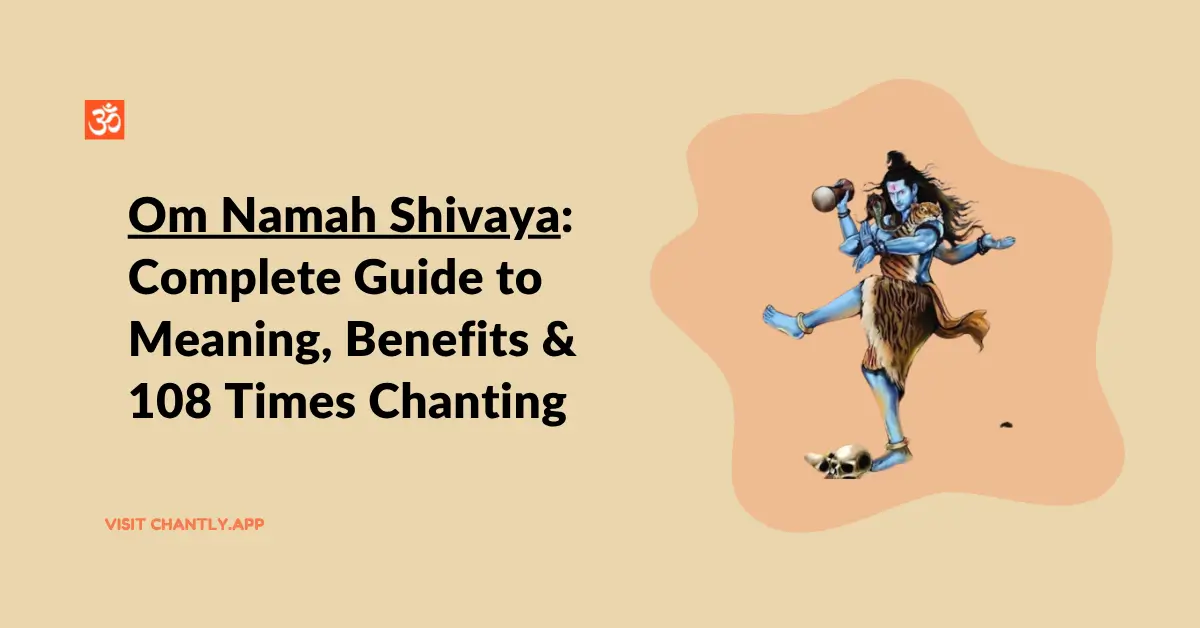
Introduction
Om Namah Shivaya is one of the most powerful and ancient Hindu mantras, dating back thousands of years to the Vedic scriptures. Revered as the most significant form of devotion in Shaivism, this six-syllable mantra appears in the Yajurveda and has been chanted by saints, yogis, and devotees for millennia seeking liberation, peace, and connection with the divine consciousness that is Lord Shiva.
Many people chant Om Namah Shivaya daily without fully understanding its profound five-syllable structure – the Panchakshara that represents the five elements of creation. Missing this deeper understanding means losing the complete transformational power encoded in each syllable. When chanted with awareness, this mantra doesn’t just praise an external deity but purifies the five elements within the practitioner, harmonizing their entire being with universal forces.
This complete guide provides everything needed to practice Om Namah Shivaya effectively: word-by-word meaning revealing how each syllable connects to earth, water, fire, air, and ether; scientific evidence of stress reduction alongside spiritual benefits; proper 108-times chanting rules including pronunciation and breath work; best times for maximum effect; and traditional guidelines that ensure respectful, powerful practice.
Whether seeking stress relief, spiritual awakening, mental clarity, protection from negativity, or deep devotion to Lord Shiva, this ancient mantra offers an accessible yet profound practice. Even Shiva himself is known as Ashutosh – easily pleased by sincere devotion responding to heartfelt chanting regardless of spiritual accomplishments.
Deep Meaning of Om Namah Shivaya
Understanding each component of this sacred mantra reveals its multidimensional power connecting individual consciousness with universal forces.
The Complete Translation:
Om Namah Shivaya translates most simply as “I bow to Shiva” or “My salutations to Shiva, the auspicious and gracious one.” But this surface translation barely scratches the depth encoded in these syllables. The mantra represents complete surrender of the ego-self to the divine consciousness residing within all beings. Shiva here refers not just to the deity with matted locks and trident but to the supreme reality the unchanging consciousness underlying all changing phenomena.
Om: The Primordial Sound
The syllable “Om” precedes the Panchakshara (five syllables) and represents the primordial sound that existed before the universe manifested. According to Vedic philosophy, Om is the vibration that created existence itself the sonic manifestation of ultimate reality. When chanting Om, practitioners connect with the fundamental frequency underlying all creation, aligning their individual vibration with the cosmic vibration.
Modern physics confirms that the universe consists fundamentally of vibration and energy rather than solid matter. Om represents this understanding in sonic form the “sound of the universe” that mystics have described across cultures and centuries.
Namah: The Act of Surrender
“Namah” translates as “I bow,” “salutations,” or “I surrender.” This isn’t passive submission but active recognition that the limited ego-self cannot navigate existence alone. Namah represents humility acknowledging that a greater intelligence pervades creation and that aligning with this intelligence brings peace and fulfilment that ego-driven striving never achieves.
The syllable also carries the meaning of “not mine” recognising that attachment to possessions, accomplishments, and even the body-mind creates suffering. Namah releases these false identifications, creating space for true self-realization.
Shivaya: The Auspicious One Within
“Shivaya” refers to Lord Shiva but simultaneously means the inner self or inner consciousness residing in all beings. Shiva literally translates as “the auspicious one,” “the benevolent one,” or “the gracious one.” By chanting Shivaya, devotees invoke these qualities both as external divine grace and as the dormant potential within their own consciousness.
Philosophically, Shiva represents pure consciousness the unchanging witness awareness that observes all experiences without being affected by them. Chanting Shivaya awakens recognition of this witness consciousness that is one’s true nature.
The Panchakshara: Five Sacred Syllables
The five syllables following Om, Na, Ma, Shi, Va, Ya encode profound cosmological wisdom about the five elements (pancha mahabhuta) that constitute all creation:
- Na = Earth Element (Prithvi) – Represents solidity, stability, form, and structure. Governs bones, muscles, flesh, everything solid in the body.
- Ma = Water Element (Jal) – Represents fluidity, flexibility, cohesion, and taste. Governs blood, saliva, digestive fluids, everything liquid in the body.
- Shi = Fire Element (Agni) – Represents transformation, digestion, metabolism, and sight. Governs body temperature, digestive fire, and all transformative processes.
- Va = Air Element (Vayu) – Represents movement, circulation, breath, and touch. Governs breathing, blood circulation, and all movement within the body.
- Ya = Ether/Space Element (Akasha) – Represents expansiveness, sound, and the container for other elements. Governs the spaces within the body and the capacity for perception.
When chanting the Panchakshara, practitioners purify and harmonize these five elements within their own body and consciousness. Since these elements constitute not just the human body but all of creation, the mantra creates harmony between individual and cosmic existence.
The Five Senses Connection:
These five syllables also correspond to the five senses that connect consciousness with the material world:
- Na governs smell (associated with earth)
- Ma governs taste (associated with water)
- Shi governs sight (associated with fire)
- Va governs touch (associated with air)
- Ya governs hearing (associated with space)
Chanting purifies the senses, refining perception and reducing attachment to sensory pleasures that create bondage and suffering.
Shiva’s Five Activities:
Traditional philosophy identifies five cosmic functions of Shiva that the syllables also represent:
- Srishti (Creation)
- Sthithi (Preservation/Maintenance)
- Samhara (Destruction/Transformation)
- Tirobhava (Concealment/Veiling)
- Anugraha (Revelation/Grace)
These functions describe the eternal cosmic cycles all that arises must eventually dissolve, and this process is neither random nor cruel but represents the divine dance of consciousness.
Vedic Origins:
The mantra appears in ancient Vedic texts including the Shri Rudram Chamakam (part of Krishna Yajurveda) and the Rudrashtadhyayi (part of Shukla Yajurveda). The original Vedic verse states: “Namah shivaya ca shivataraya ca”-“Salutation to the auspicious one and to the more auspicious.” This reveals that Shiva represents not just auspiciousness but the supreme source from which all auspiciousness flows.
Understanding this depth transforms mechanical chanting into conscious participation in cosmic harmony. Each repetition becomes an act of elemental purification, sensory refinement, ego dissolution, and alignment with the divine intelligence pervading existence.
Scientific and Spiritual Benefits
Modern science increasingly validates what ancient practitioners have known for millennia-mantra chanting creates measurable physiological, psychological, and neurological changes.
Stress Reduction and Cortisol Lowering:
Clinical studies demonstrate that mantra chanting significantly lowers cortisol-the primary stress hormone creating measurable relaxation responses. The rhythmic repetition of Om Namah Shivaya activates the parasympathetic nervous system, shifting the body from fight-or-flight stress mode into rest-and-digest relaxation mode. This isn’t merely subjective calm but objective biochemical change measurable through blood tests and stress markers.
Regular practitioners report that even during objectively stressful circumstances work deadlines, relationship conflicts, financial pressures they maintain an underlying calmness that prevents stress from overwhelming their system. The mantra essentially pre-programs the nervous system for resilience, making inevitable life stressors feel more manageable.
Anxiety Reduction and Mental Peace:
Beyond general stress relief, Om Namah Shivaya specifically reduces anxiety disorders and chronic worry patterns. Anxiety often involves racing thoughts catastrophizing about future possibilities. The mantra occupies the mind with focused repetition, interrupting the rumination cycle that fuels anxiety.
The sound vibration itself calms overactive mental activity. Modern neuroscience shows that chanting activates areas of the brain associated with emotional regulation while quieting regions linked to anxious thinking. Practitioners describe their mental landscape transforming from a stormy ocean of competing thoughts to a still lake reflecting clear sky.
Enhanced Focus and Concentration:
The practice trains attention muscles similar to how physical exercise trains the body. Each time the mind wanders during chanting (which happens constantly at first), gently returning focus to the mantra strengthens neural pathways associated with sustained attention. Over weeks and months, this enhanced concentration extends beyond practice time into daily activities.
Students report better academic performance, professionals describe improved work productivity, and meditators find deeper states more accessible all from the attention training that mantra practice provides.
Neurological Effects and Brain Wave Changes:
Neuroscience research reveals that chanting Om specifically creates vibrations resonating at the universe’s fundamental frequency. When these sound waves move through the skull, they stimulate the vagus nerve the primary nerve of the parasympathetic nervous system running from the brain through the heart and digestive organs.
This vagal stimulation activates the body’s natural relaxation response, lowering heart rate, reducing blood pressure, improving digestion, and enhancing immune function. Brain imaging shows that regular chanters develop increased gray matter in areas associated with emotional regulation and decreased activity in the amygdala (the brain’s fear center).
The practice also shifts brain waves from beta (active thinking) toward alpha and theta (relaxed awareness and meditative states), creating the neurological conditions for both deep relaxation and profound insight.
Purification of Mind, Body, and Soul:
Beyond measurable physiological effects, practitioners across centuries report profound purification occurring through consistent practice. Negative thought patterns gradually dissolve. Self-destructive habits lose their compulsive grip. Old emotional wounds seem to heal without even directly addressing them.
Traditional understanding holds that the mantra purifies sanchita karma (accumulated past karmas) and prarabdha karma (karma manifesting in current life). While this can’t be scientifically proven, countless practitioners describe life circumstances improving mysteriously obstacles clearing, relationships healing, opportunities arising after establishing sincere mantra practice.
The purification extends to all five elements within the body. Physical health often improves as elemental imbalances correct themselves. Chronic ailments sometimes resolve without medical intervention, though practitioners should never abandon necessary medical care in favor of spiritual practice alone.
Ego Reduction and Character Transformation:
Perhaps the most profound benefit involves gradual ego dissolution. The constant repetition “I bow to Shiva” slowly weakens the false identification with the limited personality-self. Pride, arrogance, defensiveness, and self-centered thinking naturally diminish without forced suppression.
This creates character transformation addressing the six traditional vices: kama (selfish desire), krodha (anger), lobha (greed), moha (delusion), mada (pride), and matsarya (envy). These aren’t eliminated through willpower but naturally fall away as consciousness shifts from ego-identification toward recognition of the divine Self.
Practitioners become naturally more compassionate, patient, generous, and humble not through moral effort but as spontaneous expression of their changing consciousness.
Spiritual Awakening and Self-Realization:
The ultimate benefit transcends all worldly improvements the mantra leads toward spiritual awakening and self-realization. By repeatedly affirming “I bow to the inner consciousness,” practitioners gradually recognize that the divine being they’re worshipping isn’t separate from their own essential nature.
This recognition doesn’t come as intellectual understanding but as direct experiential realization a shift in perspective where the separate individual self is seen as a temporary wave on the eternal ocean of consciousness. This realization brings freedom from the fear of death, attachment to outcomes, and the suffering inherent in ego-based existence.
Protection and Obstacle Removal:
On a more practical level, sincere practitioners consistently report feeling protected from harm. Negative situations seem to resolve before causing damage. Difficult people lose their power to disturb. Financial crises somehow work out. Physical dangers are narrowly avoided.
Whether this protection comes from divine intervention, improved intuition, or simply the calm clarity that makes better decisions possible remains debatable. Regardless of mechanism, the protective effect is widely experienced and valued by devotees.
Physical Health Benefits:
While not a substitute for medical care, regular chanting supports overall physical health. The stress reduction alone prevents countless stress-related illnesses heart disease, digestive disorders, autoimmune conditions, chronic pain, and more. The improved sleep quality that often accompanies regular practice allows the body’s natural healing mechanisms to function optimally.
Many practitioners report overcoming chronic illnesses, reducing medication needs, and experiencing increased vitality and energy. The fear of death which creates its own health problems through chronic anxiety diminishes significantly, creating psychological conditions for better physical health.
Enhanced Judgment and Decision-Making:
The mental clarity and emotional stability developed through practice improves decision-making abilities. Practitioners describe seeing situations more objectively, recognizing important patterns others miss, and trusting their intuition more confidently. The calm centeredness prevents reactive decisions made from anger, fear, or desire, supporting choices aligned with long-term welfare.
Desire Fulfillment:
Paradoxically, while the practice ultimately reduces attachment to desires, it often helps fulfill genuine needs and wishes. Traditional teaching holds that Shiva particularly in his Ashutosh (easily pleased) aspect grants sincere devotees’ heartfelt requests. Whether through divine intervention or the psychological confidence and clarity that make success more likely, practitioners report wishes manifesting more readily after establishing consistent practice.
Liberation (Moksha):
The supreme benefit, from traditional Hindu perspective, is moksha liberation from the cycle of birth, death, and rebirth. The mantra creates the spiritual transformation necessary for this ultimate freedom ego dissolution, recognition of one’s true nature as infinite consciousness, and release from karmic bondage. While full liberation may require years or lifetimes of practice, every sincere repetition moves consciousness closer to this ultimate realization.
The cumulative effect of all these benefits creates holistic life transformation touching physical health, mental clarity, emotional stability, relationship quality, material circumstances, and spiritual realisation making Om Namah Shivaya one of the most comprehensive practices available to spiritual seekers.
How to Chant Om Namah Shivaya – 108 Times Method
Proper technique maximizes the mantra’s transformative power while traditional structure supports consistent, sustainable practice.
Why Specifically 108 Times:
The number 108 holds profound significance across Hindu, Buddhist, and yogic traditions for multiple interconnected reasons. In Hindu cosmology, there are 108 Upanishads (sacred texts), 108 names of deities, and 108 sacred pilgrimage sites. In astronomy, the distance from Earth to the Sun is approximately 108 times the Sun’s diameter a ratio also found between Earth and Moon.
Mathematically, 108 represents a spiritually perfect number: 1 stands for God/Unity, 0 represents emptiness/completeness in spiritual practice, and 8 signifies infinity/eternity. Multiplying these concepts creates a number symbolizing the infinite divine manifesting in complete spiritual practice.
Practically, 108 repetitions create sufficient time (typically 15-20 minutes) for the mind to settle and for the mantra’s cumulative vibrational effect to build substantially. Traditional malas (prayer beads) contain exactly 108 beads, providing tactile counting that frees the mind from numerical tracking while maintaining the sacred count.
Each repetition builds energy cumulatively the 108th repetition carries far more power than the first because it rides the vibrational wave created by the previous 107. This cumulative building makes completing the full 108 far more transformative than stopping at arbitrary numbers.
Best Times for Maximum Effect:
While Om Namah Shivaya can be chanted anytime, certain periods carry special potency:
Brahma Muhurta (Early Morning): The period approximately 1.5 hours before sunrise (typically 4:00-5:30 AM) is considered the most spiritually powerful time of day. During these hours, the atmosphere remains quiet, the mind naturally inclines toward meditation, and subtle spiritual energies peak. Regular early morning practice establishes the day’s energetic foundation, carrying calmness and clarity through subsequent hours.
Mahashivratri: The “Great Night of Shiva” festival occurring annually in February/March represents the most auspicious occasion for Shiva mantras. Many devotees perform all-night chanting, sometimes repeating the mantra thousands or even tens of thousands of times. The collective devotional energy on this night amplifies individual practice exponentially.
Mondays: Every Monday (Somvar in Hindi) is dedicated to Lord Shiva. Establishing Monday morning practice of 108 repetitions creates weekly devotional rhythm honoring the tradition’s sacred calendar.
Before Meditation: Using the mantra as meditation preparation quiets mental chatter naturally, making deeper meditative states more accessible. The focused repetition acts as a bridge between ordinary consciousness and meditative awareness.
During Stress or Crisis: The mantra works powerfully as immediate stress relief during difficult moments. Even a few minutes of focused chanting during crises brings noticeable calm and often unexpected solutions to problems.
Preparation for Practice:
Create conditions supporting focused, respectful practice:
Physical Setup: Sit in any comfortable position allowing an upright spine cross-legged on the floor, kneeling on a cushion, or upright in a chair with feet flat. The spine’s straightness supports both dignified posture and unobstructed breath flow. Slouching creates physical discomfort and mental dullness that undermine practice.
Directional Orientation: Traditional practice recommends facing east (direction of rising sun, symbolizing spiritual illumination) or north (direction of Kailash, Shiva’s mythological abode). While not strictly necessary, these orientional choices honor tradition and create psychological associations supporting devotional mindset.
Rudraksha Mala: Using a Rudraksha seed mala (prayer beads) provides tactile counting mechanism while carrying symbolic connection to Shiva. Rudraksha literally means “Shiva’s tears” seeds from trees sacred to Shiva worship. Hold the mala in the right hand, using the thumb to move beads toward you (never using the index finger, which represents ego). The middle finger supports the mala while the thumb pulls each bead after one mantra repetition.
Sacred Space: While not mandatory, creating a dedicated practice space enhances consistency. Even a small corner with a Shiva image or symbol, a lamp or candle, and perhaps incense creates sensory associations that trigger devotional consciousness. The visual beauty, warm light, and pleasant fragrance all support focused practice.
The Chanting Technique – Three Levels:
Traditional teaching describes three progressive levels of mantra practice:
Vaikhari (Audible Chanting): Begin by chanting out loud at comfortable volume. Hear your own voice clearly pronouncing each syllable: “Om… Na… Mah… Shi… Va… Ya…” The external sound creates strong vibrational effects and helps maintain focus when the mind is particularly scattered. This method works well for the first round of 108 or when feeling distracted.
Upanshu (Whispered Chanting): After establishing rhythm with audible chanting, lower the volume to a soft whisper barely audible even to yourself. This creates more subtle vibration while requiring increased concentration to maintain clarity. The whispered level bridges external sound and internal mental repetition.
Manasika (Mental Chanting): The most advanced and traditionally most powerful level involves completely silent mental repetition. Only the mind “hears” the mantra no lips move, no sound emerges. This requires strongest concentration and produces the most subtle, penetrating effects. Many practitioners find this level most transformative but also most challenging to sustain without mental wandering.
A complete practice might progress through all three levels: one round audible, one round whispered, one round mental. Or beginners might stay with audible chanting until comfort and focus develop sufficiently for subtler levels.
Breath Synchronization:
Coordinate mantra repetition with natural breathing rhythm for maximum effect:
Inhale deeply through the nose, filling the lungs completely. Feel the breath descend to the belly, expanding the abdomen. This deep inhalation oxygenates blood, energizes the body, and prepares for the next repetition.
Chant on exhale, allowing the mantra to flow out naturally with the breath. The six syllables “Om-Na-Mah-Shi-Va-Ya” extend across one complete exhalation. Don’t force, rush, or hold the breath unnaturally find your natural comfortable rhythm where breath and mantra flow together effortlessly.
Brief pause before the next inhale allows the mantra’s vibration to settle. This momentary stillness between repetitions creates space for the mantra’s effect to register.
This breath-mantra coordination activates the physiological relaxation response while creating hypnotic rhythm that naturally quiets mental chatter.
Pronunciation Clarity:
Clear pronunciation of each syllable matters more than speed:
- Om: Pronounced as three phases: “A-U-M” blending into “Ommm…” Feel it resonate in the belly, chest, and head.
- Na: Short and crisp, like “nuh”
- Mah: Long “a” sound, like “maah”
- Shi: Soft “sh” followed by long “ee,” like “sheee”
- Va: Soft “v” with short “a,” like “vah”
- Ya: Short, like “yah”
Don’t worry about absolutely perfect Sanskrit pronunciation sincere devotion matters far more than linguistic perfection. However, approximate accuracy ensures the sound vibration creates intended effects.
Mental Focus During Practice:
While chanting, maintain the feeling of “I bow to Shiva” in your heart. This isn’t merely mechanical repetition but continuous act of surrender and devotion. Some practitioners find visualizing Lord Shiva’s form helpful perhaps his blue throat, third eye, crescent moon, or simply an abstract sense of divine presence.
Others prefer formless awareness simply feeling the mantra’s vibration and the conscious act of surrendering ego with each repetition. Neither approach is superior; use whatever naturally deepens your devotional connection.
Stay present with each individual repetition rather than rushing toward completion. The 108th repetition shouldn’t be the goal each repetition is complete in itself, a full offering of devotion.
When the mind wanders (which happens constantly, especially for beginners), gently return focus to the mantra without self-judgment. The noticing and returning is the practice perfection isn’t expected or even possible. Each return strengthens attention muscles.
After Completion:
After the 108th repetition, don’t immediately jump into ordinary activity. Sit in complete silence for at least 2-3 minutes, allowing the practice’s energy to integrate. Feel the stillness and peace created. Notice how your body feels, how your breath moves, how your mind’s quality has shifted.
Some practitioners bow to the altar or image of Shiva three times, touching forehead to ground in full surrender. Others simply place hands in prayer position at the heart, silently expressing gratitude. These concluding gestures honor the practice and consciously transition back toward ordinary awareness.
Progressive Practice for Beginners:
New practitioners shouldn’t feel pressured to immediately achieve perfect 108-repetition daily practice:
Week 1-2: Start with 11 or 27 repetitions daily, learning the rhythm and pronunciation without overwhelming commitment. This builds confidence and establishes the habit foundation.
Week 3-4: Increase to 54 repetitions (half a mala), deepening familiarity and beginning to experience the practice’s cumulative effects.
Week 5+: Progress to the full 108 repetitions daily or at minimum on Mondays and during Mahashivratri.
This graduated approach builds sustainable practice rather than creating unsustainable intensity that leads to abandonment after initial enthusiasm fades.
Advanced Practice:
Once 108 daily repetitions feel comfortable and sustainable, some practitioners extend their practice:
- 216 repetitions (2 malas) daily
- 324 repetitions (3 malas) on special occasions
- 1,008 repetitions during Mahashivratri or for specific intentions
- 100,000+ repetitions as a major spiritual undertaking (called purascharana), typically done over several months with specific discipline and often under a guru’s guidance
However, consistent simple practice outweighs occasional intensive practice. Daily 108 repetitions maintained for years transforms consciousness more profoundly than sporadic marathon chanting sessions.
The technique’s beauty lies in its simplicity sit, chant, bow. This accessible structure allows anyone, regardless of spiritual background or philosophical knowledge, to begin immediately and experience tangible benefits within days while supporting lifelong deepening for advanced practitioners.
Rules and Important Guidelines
Understanding traditional guidelines ensures respectful, effective practice while avoiding common pitfalls that undermine the mantra’s power.
Who Can Chant – Traditional and Modern Perspectives:
Traditional Sanskrit texts make distinctions about who can chant different versions of this mantra:
The Five-Syllable Version (Na-Mah-Shi-Va-Ya without Om) can be chanted by absolutely everyone, including shudras and chandalas castes traditionally excluded from Vedic practices. This universal accessibility demonstrates the mantra’s democratic spiritual power transcending social hierarchies.
The Six-Syllable Version (Om-Namah-Shivaya with Om) was traditionally reserved for dvijas (twice-born castes who had undergone sacred thread ceremony). However, modern Shaivite teachers increasingly teach that in Kali Yuga (the current age), all sincere seekers may chant the full six-syllable mantra. The spiritual emergency of modern times supersedes caste restrictions designed for earlier ages.
No gender restrictions apply women are absolutely welcome and encouraged to chant Om Namah Shivaya. Unlike some Vedic mantras restricted to men, this Shaivite mantra honors both masculine and feminine divine principles.
No initiation required: Unlike certain advanced mantras (like specific Shakti mantras) requiring formal initiation from a qualified guru, Om Namah Shivaya can be self-initiated. Simply beginning sincere practice constitutes sufficient preparation. That said, receiving the mantra from a guru within a lineage adds traditional blessing and spiritual connection that some practitioners value.
The essential principle: sincere devotion matters infinitely more than birth circumstances, gender, or formal initiation. Shiva as Ashutosh (easily pleased) responds to heartfelt chanting regardless of the chanter’s background.
Physical Preparation:
While not absolutely mandatory, traditional preparation optimizes practice:
Bathing: Ideally, bathe or at least wash hands, feet, and face before chanting. Physical cleanliness symbolizes and supports mental purity, creating the sense of approaching something sacred rather than treating practice as ordinary activity squeezed between other tasks.
Clean Clothing: Wear freshly laundered, comfortable clothes. Many practitioners designate specific clothes for spiritual practice, creating psychological associations that trigger devotional consciousness.
Light Stomach: Chanting on a completely empty stomach (early morning before breakfast) or at least 2-3 hours after eating prevents digestive discomfort and the mental dullness that follows heavy meals. The body’s energy goes toward spiritual practice rather than digestion.
Avoid Intoxicants: Don’t consume alcohol, recreational drugs, or even excessive caffeine before practice. These substances alter consciousness in ways that interfere with the mantra’s subtle effects. Ideally, regular practitioners maintain general moderation or abstinence from intoxicants as lifestyle rather than just pre-practice restriction.
These physical preparations aren’t puritanical rules but practical guidelines supporting focused, powerful practice. However, during spontaneous difficult moments requiring immediate mantra support, chant regardless of preparation state the Divine responds to sincere hearts under all circumstances.
Mental Attitude – The Most Important Element:
Physical rules pale in importance compared to mental approach:
Full Faith and Devotion: Chant with complete confidence in the mantra’s power and in Shiva’s grace. Doubt and half-hearted practice severely limit results. This doesn’t mean blind belief but rather suspension of skepticism long enough to genuinely test the practice through consistent application.
Feeling of Surrender: Maintain the heart-feeling of “I bow” throughout practice. This isn’t merely words but actual release of ego-control, trusting that divine intelligence guides your life better than limited personal understanding.
Present-Moment Awareness: Stay conscious with each repetition rather than rushing mechanically toward completion. Quality of attention matters more than quantity of repetitions.
Non-Expectation: Paradoxically, while having faith in results, don’t grasp at specific outcomes or constantly evaluate progress. Trust the practice’s effects to unfold naturally without anxious monitoring. This relaxed confidence allows transformation to occur organically.
Consistency Over Intensity:
The ancient principle “regularity is the secret of success” applies powerfully to mantra practice:
Daily Practice: Even 10-15 minutes daily (approximately 50-75 repetitions) creates more transformation than occasionally practicing for hours. The continuous daily contact with the mantra builds cumulative momentum that occasional intensive sessions cannot match.
Same Time Daily: If possible, practice at the same time every day. This regularity trains the body-mind system to anticipate and prepare for practice, making it progressively easier to enter focused states.
Minimum 40 Days: Traditional teaching holds that 40 days of unbroken practice creates lasting transformation. This timeframe allows new neural pathways to form and the mantra to penetrate deep subconscious patterns. Commit to at least 40 consecutive days before judging the practice’s effectiveness.
Lifelong Practice: Ideally, Om Namah Shivaya becomes lifelong companion a practice sustained daily for years or even decades. The deepest transformations occur through this sustained commitment, though every practice period provides benefits regardless of future consistency.
What to Avoid – Common Mistakes:
Certain approaches undermine practice effectiveness:
Don’t Chant While Agitated: If feeling extremely angry, anxious, or emotionally disturbed, take a few minutes to calm somewhat before beginning formal practice. While the mantra helps process difficult emotions, starting from extreme agitation makes focused chanting nearly impossible. A few deep breaths or brief walk first prepares consciousness for effective practice.
Don’t Rush Mechanically: Speed doesn’t increase benefits. Racing through 108 repetitions in five minutes to check a box accomplishes little. Slower, conscious repetition with full attention outweighs rapid mechanical recitation every time.
Don’t Practice Half-Heartedly: If committing to practice, fully commit for that session’s duration. Mentally multitasking planning the day, mentally composing emails, running through to-do lists while mechanically chanting wastes everyone’s time, particularly yours.
Don’t Doubt or Test: Approaching practice with constant skeptical evaluation (“is this working yet?”) prevents the surrender necessary for transformation. Commit to at least 40 days of sincere practice before judging effectiveness.
Don’t Brag or Display: Traditional teaching warns against discussing spiritual practices excessively or displaying devotion ostentatiously. The ego co-opts spiritual practice remarkably easily, transforming genuine devotion into subtle pride about one’s spirituality. Keep practice somewhat private, sharing selectively with fellow sincere practitioners rather than broadcasting achievements.
Integration with Daily Life:
The mantra extends beyond formal practice sessions:
Silent Mental Repetition: Once the mantra becomes familiar through formal practice, it can be chanted silently anytime during commutes, while walking, during boring meetings, while waiting in lines. This informal practice extends benefits throughout the day.
Stress Management Tool: Use the mantra during difficult moments for instant calm. Even 1-2 minutes of focused repetition during crises brings noticeable relief and often unexpected solutions.
Sleep Practice: Some practitioners chant mentally while falling asleep, allowing the mantra to continue in subconscious awareness through the night. Others report waking with the mantra spontaneously arising in consciousness a sign of deep integration.
Combination with Other Practices: Om Namah Shivaya combines beautifully with other spiritual practices yoga asanas, pranayama, meditation, devotional worship, selfless service. The mantra forms excellent foundation supporting any spiritual path rather than conflicting with other practices.
Family Practice: Teaching children the mantra creates beautiful family tradition while giving them a lifelong tool for stress management and spiritual connection. Chanting together before meals, at bedtime, or during family challenges strengthens bonds while establishing shared devotional practice.
Special Occasions and Vows:
Some practitioners make special commitments:
Mahashivratri Vows: Committing to 1,008 or more repetitions during Mahashivratri, often combined with fasting and nightlong vigil, creates intensive devotional experience with amplified benefits.
40-Day Anushthana: Committing to specific number of daily repetitions (often 108, 216, or 324) for 40 consecutive days without break creates powerful spiritual transformation. Traditional teaching holds that completing this commitment with full sincerity and discipline fulfills wishes and grants spiritual attainments.
Purascharana: The major undertaking of 100,000 or more repetitions over several months, following strict discipline regarding diet, celibacy, schedule, and devotional attitude. This advanced practice typically occurs under guru guidance and creates profound transformation.
However, simple daily practice without elaborate vows or special commitments suffices for most practitioners. The mantra’s power lies not in complex rules but in sincere, consistent repetition with devotional heart.
The guidelines ultimately serve one purpose: creating conditions where sincere devotion can flourish and the mantra’s transformative power can fully manifest. While respecting traditional wisdom, modern practitioners should avoid getting lost in rule-following at the expense of heartfelt practice itself. Shiva cares about the heart’s sincerity far more than perfect rule adherence.
Conclusion
Om Namah Shivaya the five-syllable Panchakshara mantra preceded by the primordial Om offers comprehensive spiritual practice combining ancient Vedic wisdom with scientifically-proven benefits. Each syllable purifies one of the five elements constituting all creation, while the complete phrase dissolves ego identification and awakens recognition of the divine consciousness within.
The practice provides measurable stress reduction through lowered cortisol, enhanced mental clarity through improved focus, emotional stability through regulated nervous system function, and physical health benefits through activated relaxation responses. Beyond these worldly improvements, consistent sincere practice leads toward the ultimate goal spiritual awakening and liberation from the suffering inherent in ego-based existence.
Begin your practice tomorrow morning start with just 11 repetitions to learn the rhythm and pronunciation without overwhelming commitment. Feel the words: Om… Namah… Shivaya. I bow to the divine consciousness within and without. Gradually increase to 27 repetitions over the first week, then 54 by week three, building toward the traditional 108 by week five.
Invest in or create a simple Rudraksha mala with 108 beads the tactile counting frees your mind for devotional focus. Establish Monday morning as your committed practice time, honoring Shiva’s sacred day. During Mahashivratri, extend practice to multiple rounds, joining millions of devotees worldwide in collective celebration of the Divine.
Commit to 40 consecutive days before judging effectiveness this minimum timeframe allows the mantra to penetrate surface consciousness and begin working at deeper subconscious levels. Track your practice in a journal, noting not just completion but shifts in mood, clarity, and life circumstances.
Whether seeking immediate stress relief, long-term spiritual development, protection from negativity, physical healing, mental clarity, or ultimate liberation, Om Namah Shivaya offers an accessible yet infinitely profound practice. Shiva is known as Ashutosh easily pleased by sincere devotion responding to heartfelt chanting regardless of spiritual accomplishments, caste background, or religious affiliation.
The mantra doesn’t require belief in Hindu theology, guru initiation, or philosophical understanding to work effectively. Simply sit, chant with sincere heart, bow in humble recognition that something greater than ego guides existence, and watch transformation unfold naturally through consistent practice.
Millions across centuries from illiterate villagers to enlightened sages have found this mantra sufficient for complete spiritual fulfillment. The path requires no special qualifications, only willingness to begin and consistency to continue. Start today, and discover why this ancient sound continues transforming consciousness in our modern age.
Count your 108 with Chantly.
Tap the circle to try it. In the app, the counter keeps your rounds and stays private to you.

Chantly's guides are written and checked by the Chantly editorial team. Read our editorial policy.